
Reviewed · DOWNTOWN TORONTO WALKING TOURS
Toronto’s Waterfront: a Smartphone Audio Walking Tour
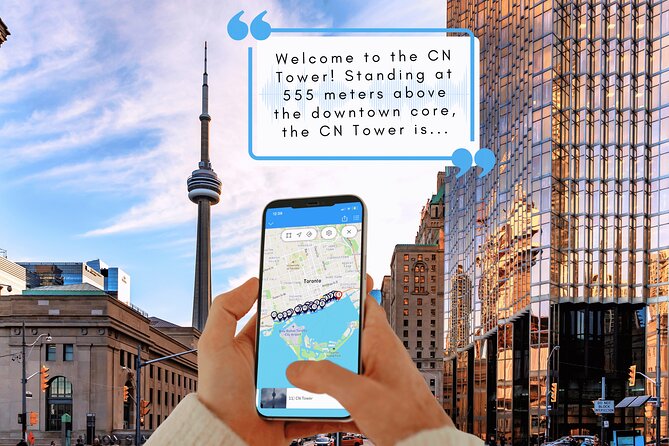
Toronto’s waterfront talks back on your phone. This smartphone audio walking tour guides you along the Lake Ontario waterfront with automatic commentary and a live route map. You’ll pass big-name sights like the CN Tower and Rogers Centre, plus calmer parks and public art.
I like how this tour lets you explore at your pace, which makes it a great fit if you hate crowd-control or rushing. I also like the live GPS feature, because the audio cues play when you’re actually near each spot. The main thing to consider is you’ll be using your own phone the whole time, so bring a charged battery and download the audio beforehand.
In This Review
- Key highlights you’ll feel right away
- The “smart tour guide” approach along Toronto’s waterfront
- What $8.21 buys you (and what it doesn’t)
- Getting started at Sugar Beach (and why the route matters)
- Sugar Beach to Queens Quay East: views plus the industrial storyline
- Stop 1: Sugar Beach
- Stop 2: Lower Jarvis Street & Queens Quay East
- Stop 3: Redpath Sugar Toronto
- Stop 4: One Yonge Street (Toronto Star Building)
- Stop 5: Yonge Street & Queens Quay West
- Jack Layton to the Power Plant: civic landmarks and a calmer pace
- Stop 6: Statue of Jack Layton
- Stop 7: York Street & Queens Quay West
- Stop 8: The Power Plant
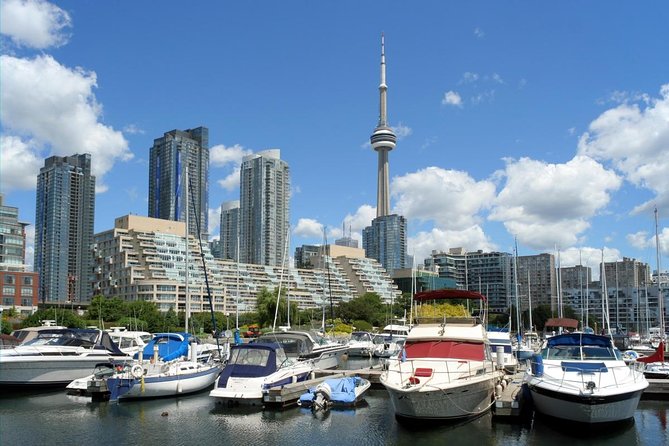
- WaveDeck, CN Tower, Rogers Centre, and HTO Park: the skyline section
- Stop 9: Simcoe WaveDeck
- Stop 10: CN Tower
- Stop 11: Rogers Centre
- Stop 12: HTO Park
- Spadina, the Music Garden, and Billy Bishop: culture, whimsy, and airport views
- Stop 13: Spadina Avenue & Lake Shore Boulevard West
- Stop 14: Toronto Music Garden
- Stop 15: Queens Quay West & Bathurst Street (Billy Bishop Airport view)
- Little Norway, Navy history, and the Martin Goodman Trail
- Stop 16: Little Norway Crescent
- Stop 17: Waterfront Trail
- Stop 18: HMCS NCSM York
- Stop 19: Martin Goodman Trail
- Princes’ Gates: your finish line and the CNE connection
- Stop 20: Princes’ Gates
- What the audio experience feels like while you walk
- Who this Toronto waterfront tour is best for
- Should you book the Toronto Waterfront smartphone tour?
- FAQ
- Where does the tour start and end?
- How long should I plan for?
- What language is the tour offered in?
- Do I need cellular data during the walk?
- Can I pause and continue later?
- Are tickets for CN Tower and Rogers Centre included?
- Do I need headphones?
- What if I’m booking for multiple people?
Key highlights you’ll feel right away
- Self-paced walking with no time constraints, so you can linger or skip bits
- Live GPS map that shows your location and where to go next
- Automatic audio that starts when you get close to each stop
- Location-based trivia game you answer right on your device
- Budget-friendly at $8.21, with most stops requiring no tickets
The “smart tour guide” approach along Toronto’s waterfront
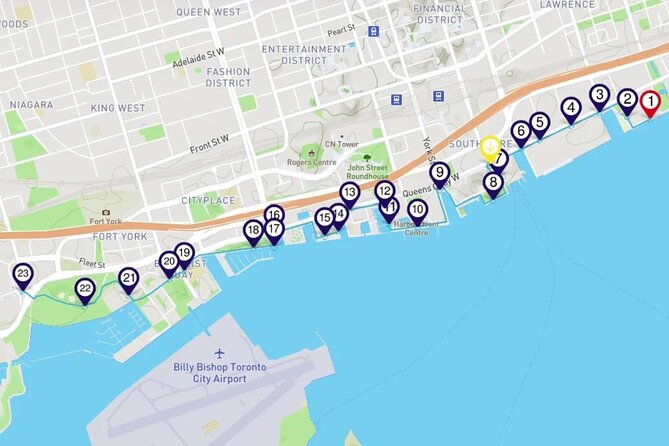
This is a walking tour built for independence. Instead of meeting a guide in person and staying glued to a group, you carry the tour with you. The route is a classic waterfront loop: about 4.5 km of sightseeing from Sugar Beach to Princes’ Gates.
You’re guided in two ways. First, the tour includes a live GPS map showing your position and the next stop. Second, the audio is set to play automatically as you near each landmark, so you don’t need to constantly tap around to figure out what’s next.
The tour also adds a light game element: after the commentary plays, you’ll be prompted with a trivia question and you tap your guess on your screen. It’s a small thing, but it helps keep your brain awake on a long stretch of sidewalk.
Lace up for more downtown Toronto walking tours around Toronto



What $8.21 buys you (and what it doesn’t)
At $8.21 per person, you’re paying for a professional-style narration plus navigation help—without the higher cost of traditional guided tours. In return, you’re not paying for attraction entry tickets. That’s a good deal if your goal is to see and understand the waterfront from outside and from public spaces.
The tour is also designed so you can fit it between other plans. One review noted it worked perfectly as a fill-in activity during gaps between bigger attractions, and that matches the vibe here: it’s a couple of hours of structured context while you walk.
Getting started at Sugar Beach (and why the route matters)

Your tour begins at Sugar Beach, in the St Lawrence-East Bayfront area. This start point is smart: you get waterfront views immediately, and you’re positioned to understand what the rest of the walk is about—Toronto’s skyline from the water, plus the city’s layers as it grew around the waterfront.
As you move, you’ll follow a sequence of stops that cover a mix of:
- waterfront parks and views
- industrial and working-city landmarks
- transit and cultural spots
- big skyline icons at the center of Toronto’s modern identity
You’ll also notice the tour is easy to do in one direction or the other. The experience is said to be very similar either way, so you can match the walk to how you want to end your day.
Sugar Beach to Queens Quay East: views plus the industrial storyline
This segment is where the tour shifts from scenic to explanatory. You’ll start with the big waterfront feel, then quickly move into the working past that shaped Toronto.
Stop 1: Sugar Beach
You get your first chunk of storytelling right where the waterfront is most inviting. You’ll explore the area with guided audio, picking up what to look for as you take in major skyline elements like the CN Tower and Rogers Centre from along the shore.
More walking tours to stroll on foot through Toronto






Stop 2: Lower Jarvis Street & Queens Quay East
Here, the tour sets up the next part of the story with a quick pre-cursor. The focus is Toronto’s industrial past, and how that industry mattered for the city’s development. This is useful because Toronto’s waterfront isn’t just a pretty edge—it was part of how the city functioned.
A small drawback: this section is more “interpretation” than “must-see attraction.” If you’re expecting a constant parade of dramatic sights, this stretch may feel a bit more like learning than photographing.
Stop 3: Redpath Sugar Toronto
Next comes an iconic factory on the waterfront. The audio points out the Redpath Sugar site and shares some history. Even if you don’t know the name yet, it’s the kind of landmark that helps explain why the waterfront looks the way it does—industry and infrastructure were right here.
Stop 4: One Yonge Street (Toronto Star Building)
This stop brings in media history. You’ll spot the Toronto Star Building and learn about its longtime tenant that has produced newspapers since 1892. It’s a reminder that Toronto’s waterfront wasn’t only about ships and factories—it was also about communication and daily life.
Stop 5: Yonge Street & Queens Quay West
You’ll be told about Yonge Street and a fun fact: it once held a Guinness World Record for the longest road. It’s brief, but it adds a bit of pop trivia to balance out the heavier context.
Jack Layton to the Power Plant: civic landmarks and a calmer pace
By now, you’ve gone from waterfront beauty to industry to media and landmarks. This next stretch slows down the tone with civic and cultural stops.
Stop 6: Statue of Jack Layton
You’ll see the statue and the Jack Layton Ferry Terminal. The audio tells you about Jack Layton himself, tying a modern public figure to the waterfront’s transportation role. It’s a good example of how the tour connects the city’s people to the places they used to move through.
Stop 7: York Street & Queens Quay West
This is a view stop. You’ll get guided help to find a good look at the island area. If you like photography, this is the kind of stop where you’ll naturally want a couple extra minutes.
Stop 8: The Power Plant
You’ll see the Power Plant Contemporary Art Gallery and hear why you might want to visit. Since attraction entry isn’t included, this one is more about deciding whether that visit is worth your time later—useful if you’re weighing which indoor stops to add on.
WaveDeck, CN Tower, Rogers Centre, and HTO Park: the skyline section
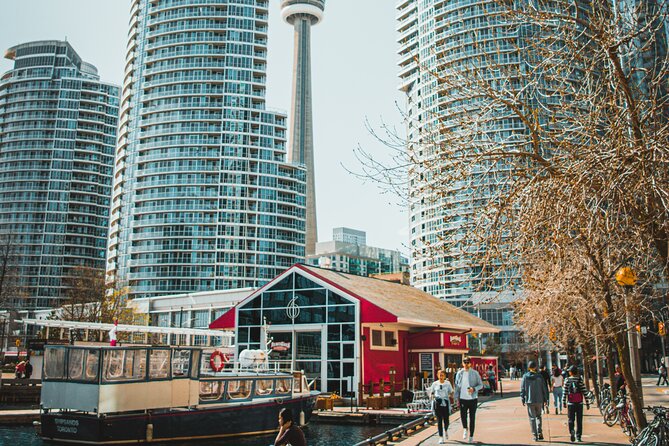
Now the tour lands on the biggest visual payoff. This is where the waterfront feels most like a postcard—then the audio adds the “why,” not just the “what.”
Stop 9: Simcoe WaveDeck
This one is about public art you can literally walk on. The tour points out the Simcoe WaveDeck and explains it as art rather than a warped surface. Even if you don’t stop long, it’s a quick way to understand Toronto’s taste for playful design in public spaces.
Stop 10: CN Tower
There’s no pretending you won’t notice the CN Tower. The audio gives context about the tower’s significance, including that it was once the world’s tallest building. You’ll get enough detail to make your later day feel more connected, instead of just staring and moving on.
Note: CN Tower admission is not included, so you’ll likely admire it from outside unless you plan to ticket separately.
Stop 11: Rogers Centre
The tour covers the Rogers Centre and reminds you it’s home to the Blue Jays. Again, this is mainly an outside-or-street-level learning stop—tickets aren’t included.
Stop 12: HTO Park
As you stroll through the park, you’ll hear a quick explanation of where the name HTO Park comes from. This is the kind of “small fact” that makes parks feel less random and more intentional.
Spadina, the Music Garden, and Billy Bishop: culture, whimsy, and airport views

This segment is a mix of street texture, design, and an unusual view at the waterfront edge.
Stop 13: Spadina Avenue & Lake Shore Boulevard West
You’ll get a view of one of Toronto’s busiest streets. The audio adds a quirky detail: you’ll have the chance to listen to a song from the 80s about the Spadina Bus. It’s a fun break from pure architecture facts and it makes the city feel lived-in.
Stop 14: Toronto Music Garden
This stop shifts to calm and design. You’ll meander through the Toronto Music Garden and learn about the unique story behind the design. Since the tour is self-paced, this is a great place to slow down and take your time.
Stop 15: Queens Quay West & Bathurst Street (Billy Bishop Airport view)
This is a standout “only-in-Toronto” moment: you’ll look toward Billy Bishop Airport on the island, with an explanation of it as part of the waterfront scene. If you’ve never seen an airport framed by city waterfront views, you’ll get it fast.
Little Norway, Navy history, and the Martin Goodman Trail
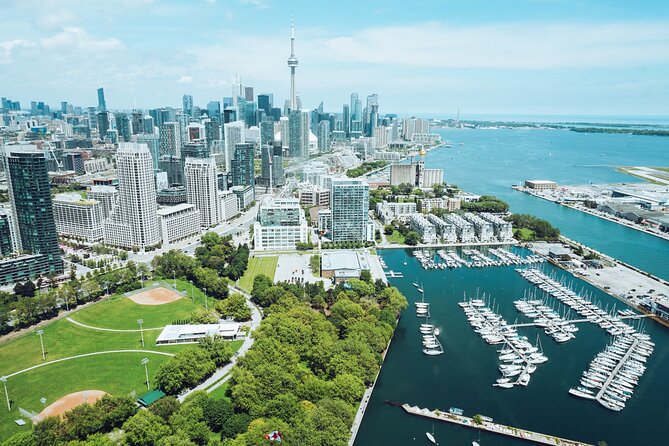
These stops add depth to the walk by showing how memory, military history, and long-distance paths connect along the shore.
Stop 16: Little Norway Crescent
You’ll point out this small park and learn it was created to commemorate World War Two. Even a short stop here can make the waterfront feel more reflective than just scenic.
Stop 17: Waterfront Trail
The audio explains the waterfront trail you’ll be walking as you continue. This helps you see the trail as more than a sidewalk—it’s a system for moving along the city’s edge.
Stop 18: HMCS NCSM York
Now you’re in the Navy now, at least in theme. You’ll see HMCS NCSM York and hear why it has been a waterfront fixture since 1959 and what its purpose is. This is one of the more “you learned something real” stops, because it gives the human role behind a static display.
Stop 19: Martin Goodman Trail
The tour highlights a portion of the Martin Goodman Trail, noting it spans the waterfront for over 20 km. This context helps you understand that the route you’re doing is only a slice of a much longer waterfront experience.
Princes’ Gates: your finish line and the CNE connection

You’ll end at Princes’ Gates, the entrance to the CNE. It’s a fitting finale because this is a major city threshold: you’ve walked through industry, culture, parks, and landmarks, and you arrive at a place that signals big events and gathering.
Stop 20: Princes’ Gates
The audio shares details about the gates and how the Canadian National Exhibition (CNE) takes place annually inside. Even if you’re not visiting during CNE season, you’ll understand why this spot matters.
You’ll also be guided to notice island views from the path near the end. The tour doesn’t force extra wandering, but it’s the kind of area where you naturally want to spend a few minutes just looking over the water.
What the audio experience feels like while you walk
The biggest strength here is the format. Since commentary plays automatically as you near points of interest, you’re not constantly checking your map or asking what the next step is. You’re just walking.
Also, the tour is designed with flexibility in mind:
- there are no time constraints
- you can stop and start whenever you like along the route
- you can download it and use it beyond your exact booking time (it’s described as flexible dates, yours to keep and enjoy anytime)
That flexibility is a real quality-of-life feature. One review described the tour as bite-sized and perfect for filling gaps between major activities, and that’s exactly how it works. You can treat it like a structured stroll rather than a strict schedule.
A practical note: headphones are optional. The tour says audio will play from your device speaker too, but if you’ll be in a noisy area, you might prefer headphones even though they’re not included.
Who this Toronto waterfront tour is best for
This tour is a strong match if you:
- don’t want crowded group tours
- want an easy introduction to Toronto’s waterfront
- like learning in small chunks while you walk
- prefer self-guided flexibility instead of tight timing
It’s also a good choice for first-time visitors. The route hits the waterfront’s main identities: views, landmarks, public art, and the city’s working past—so you leave with a clearer sense of where things are and how they connect.
It’s less ideal if you’re chasing indoor ticketed highlights as your primary goal. Since CN Tower and Rogers Centre admission aren’t included, you’ll mostly be looking and learning from outside unless you add separate tickets.
Should you book the Toronto Waterfront smartphone tour?
I’d book it if you want a low-cost, low-stress way to understand Toronto’s waterfront without dealing with a big tour group. For $8.21, you’re buying guidance, an automatic audio guide, and a simple GPS map—and you can stretch the walk to fit your day.
Skip it only if you don’t want to rely on your phone at all, or if you’re hoping the tour includes attraction entry. If your plan is mostly outdoor sightseeing, this is a smart value. If your plan is mostly ticketed attractions, you’ll still like the guidance, but you’ll want to budget extra for the places that aren’t included.
FAQ
Where does the tour start and end?
The tour starts at Sugar Beach, St Lawrence-East Bayfront-The Islands, ON M5A 1J1, Canada. It ends at 800 Lake Shore Blvd W, Toronto, ON M6K 0E1, and the end point is at Princes Gates.
How long should I plan for?
The experience runs about 45 minutes to 1 hour 30 minutes, and it says you can take as much time as you like with no time constraints.
What language is the tour offered in?
The tour is offered in English.
Do I need cellular data during the walk?
No. The tour says you should download on WiFi before, and during the tour there is no signal required and no data used.
Can I pause and continue later?
Yes. The tour is described as having no time constraints, and you can stop and start anywhere along the route.
Are tickets for CN Tower and Rogers Centre included?
No. Attraction tickets are not included, and the CN Tower and Rogers Centre stops specifically list admission not included.
Do I need headphones?
Headphones are optional. The audio can play from your device speaker as well.
What if I’m booking for multiple people?
The number of travelers you select is the number of devices you can download the tour to.
More Downtown Toronto Walking Tours
More Tour Reviews to line up around Toronto and Niagara



Not sure yet? Here is more to see and do across Toronto, just reviewed












More Downtown Toronto Walking Tours to size up.
 ★ 5.0Show me the City! A Small Group Walking Tour of TorontoFrom $39621 reviews
 ★ 5.0Downtown Toronto Bike TourFrom $93336 reviews
 ★ 4.5Old Town Toronto Highlights 3 Hour Walking Tour | Gratuity-BasedFrom $5290 reviews
 ★ 4.7Private Walking Tour with a LocalFrom $43150 reviews
 ★ 4.5Old Town Toronto History Walking TourFrom $4122 reviews
 ★ 4.42-Hour Downtown Walking TourFrom $28101 reviews
 ★ 4.8Old Toronto by Beer: A Craft Brew AdventureFrom $7191 reviews
 ★ 4.9Brothels of Old Toronto Walking TourFrom $1971 reviews
This tour also ranks in